A faceless YouTube channel is exactly what it sounds like: a YouTube channel that generates views, subscribers, and ad revenue without anyone appearing on camera. No face. No personality-driven vlogs. No ring light. You never show up, and the channel still grows.
The content is built from stock footage, screen recordings, AI-generated visuals, motion graphics, or a combination of all four. The voiceover is either AI-generated or hired out for $5-$20 per script. The editing is outsourced. The scripting follows proven frameworks. And the channel owner, you, is the project manager, not the talent.
I run two of these myself, Across the Globe and Nutty History. Combined, they've done over $155K in the last five months. I've never appeared in a single video on either channel. The editors, scriptwriters, and voiceover talent do the production. I manage the system. That's the model, a media company you own, not a personal brand you perform.
A faceless channel is a digital asset, not a content hobby. You build it like a business, systems, delegation, data, and it pays you whether you show up on a given Tuesday or not. That's the entire point.
YouTube's ad revenue crossed $30 billion in 2024 and keeps climbing. The platform isn't slowing down, it's accelerating. And faceless channels are disproportionately benefiting because of three compounding shifts.
First: AI tools collapsed production costs. What used to cost $200-$500 per video (scriptwriter + editor + voiceover + footage licensing) now costs $30-$80. AI scripting tools write first drafts in minutes. AI voiceover is indistinguishable from human at the mid-tier level. Stock footage libraries are either included in your editing software or cost $10/month. The cost floor dropped, and the margin ceiling went up.
Second: YouTube's algorithm doesn't care about your face. It cares about click-through rate, average view duration, and session time. A well-titled, well-thumbnailed faceless video in a high-demand niche will outperform a mediocre face-to-camera video every single time. The algorithm rewards content quality, not creator identity.
Third: the creator burnout wave opened space. Face-to-camera creators are burning out at record rates. The "post every day, be authentic, never take a break" model is unsustainable and everyone knows it. Faceless channels don't have that problem. The system runs without a personality bottleneck. You can take a two-week vacation and come back to more revenue than when you left.
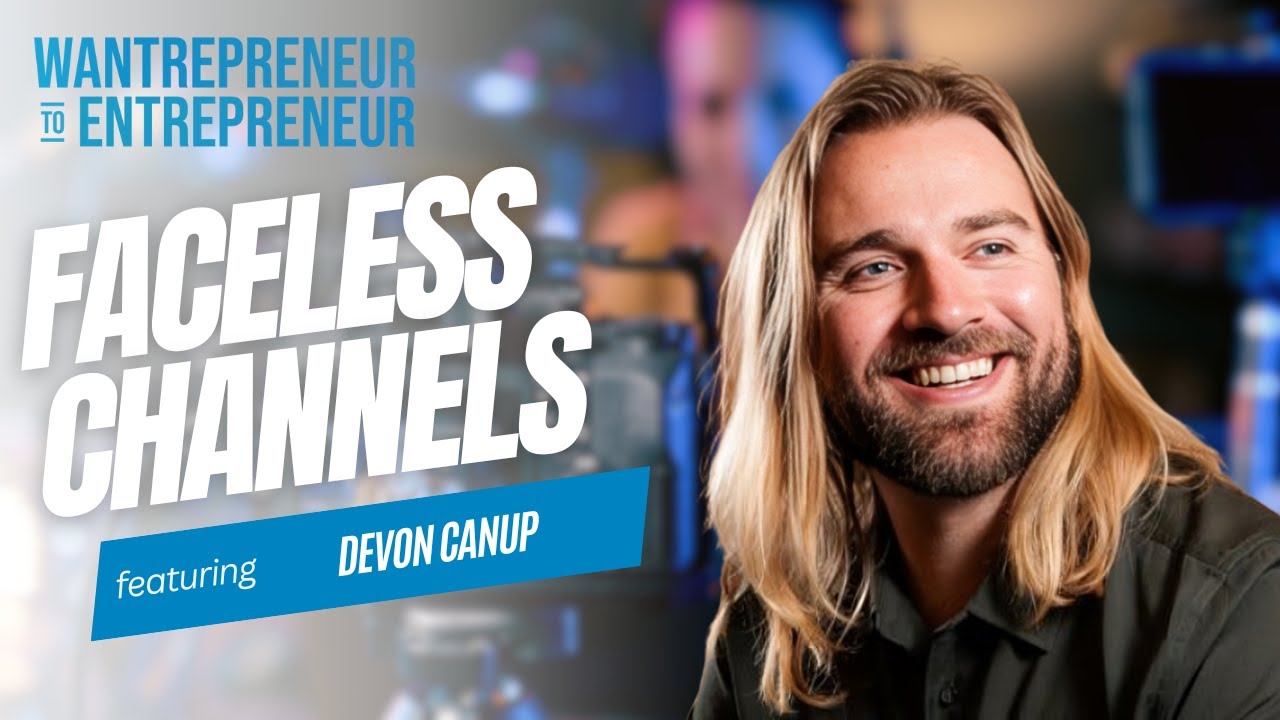

I'm not going to give you hypotheticals. Here are the actual AdSense numbers from my own faceless channels, Across the Globe and Nutty History, over the last five months.
| Month | Combined AdSense Revenue | Videos Published |
|---|---|---|
| November 2025 | $42,408 | ~30 |
| December 2025 | $43,671 | ~30 |
| January 2026 | $19,972 | ~25 |
| February 2026 | $17,747 | ~25 |
| March 2026 | $32,149 | ~28 |
That's $155,947 in five months from AdSense alone, before sponsorships, affiliates, or any other monetization. November and December spiked because Q4 ad spend is always the highest, advertisers dump budgets before year-end. January dropped (it always does, the "January dip" is real), then March climbed back up as advertiser budgets reset.


This isn't unusual for established channels in the right niches. It is unusual for people who don't show their face, don't edit their own content, and spend less than 10 hours a week managing the operation. That's the leverage.
Revenue fluctuates month to month. Q4 (Oct-Dec) will always be your highest-earning quarter due to holiday ad spend. Q1 (Jan-Mar) dips. Plan your cash flow accordingly and don't panic when January hits. The annual trend is what matters.
RPM, Revenue Per Mille, is how much you earn per 1,000 views. It's the single most important number in faceless YouTube because it determines whether 100,000 views makes you $200 or $4,500. And the gap is enormous.
Here's what I'm seeing across my own channels and the 1,200+ students inside FCA in 2026:
| Niche | RPM Range | 100K Views = | Difficulty |
|---|---|---|---|
| Finance / Investing | $15, $45 | $1,500, $4,500 | High |
| Real Estate | $15, $40 | $1,500, $4,000 | High |
| Business / Entrepreneurship | $12, $35 | $1,200, $3,500 | Medium-High |
| Tech / AI | $10, $30 | $1,000, $3,000 | Medium |
| Health / Fitness | $8, $20 | $800, $2,000 | Medium |
| Lifestyle / Luxury | $5, $15 | $500, $1,500 | Low-Medium |
| Gaming | $2, $8 | $200, $800 | Low |
The takeaway is brutal but important: niche selection determines roughly 80% of your revenue ceiling. A finance channel with 500K monthly views earns as much as a gaming channel with 3 million. Same effort. Same number of videos. Completely different outcome. This is why I spend so much time on niche validation inside FCA before a single video gets made.
That said, high RPM doesn't automatically mean high difficulty. Some finance sub-niches (credit building, budgeting for beginners) are far less competitive than you'd think. And some "easy" niches like gaming have such low RPMs that you'll grind for years and barely cover your costs.
One of the biggest misconceptions is that faceless YouTube is expensive. It's not. Compared to literally any other business model that generates this kind of return, the cost structure is absurd.
| Expense | Monthly Range | Notes |
|---|---|---|
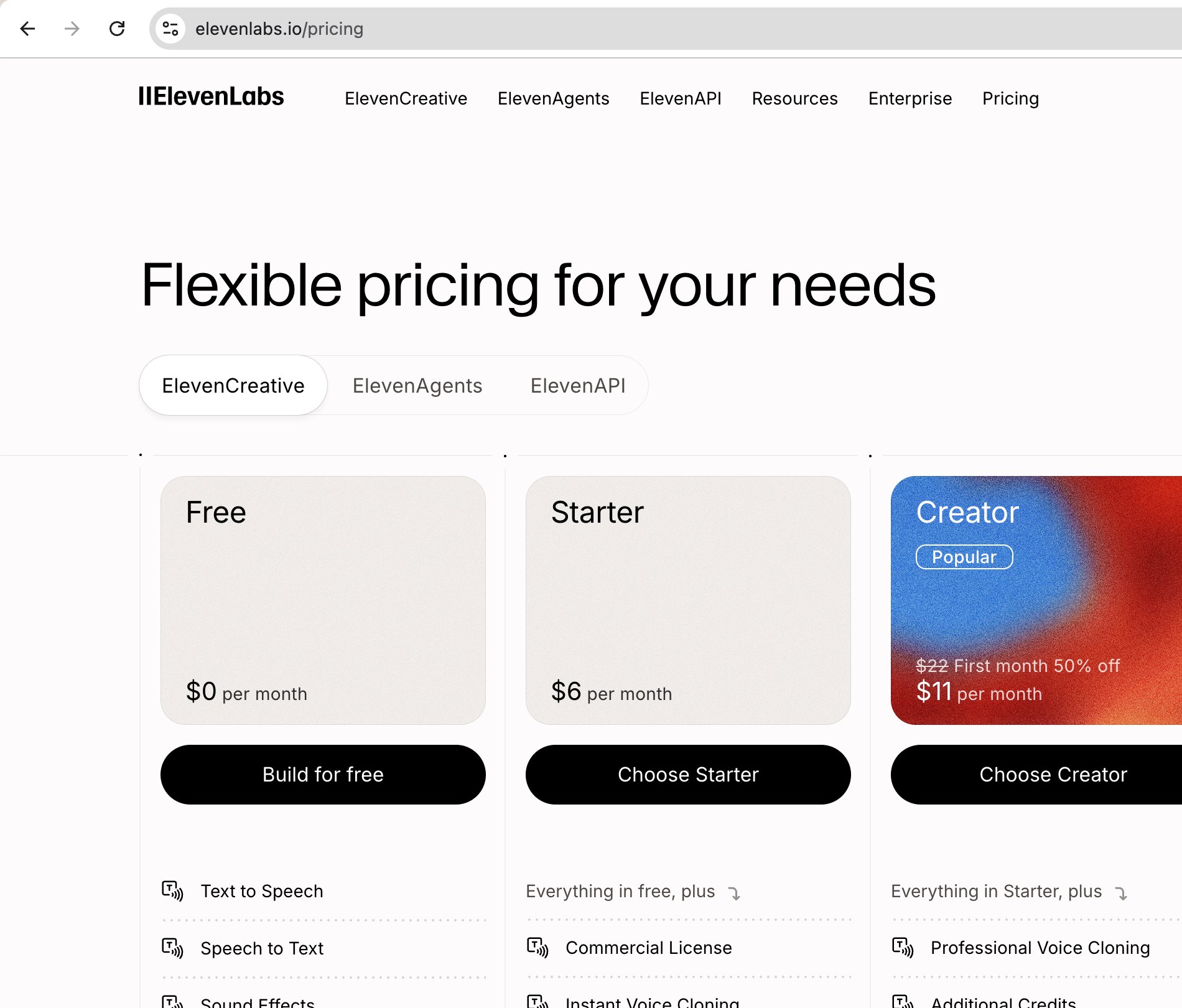
| AI Tools (scripting, voiceover) | $50, $200 | ChatGPT, ElevenLabs, or similar |
| Stock Footage | $30, $100 | Storyblocks, Pexels Pro, Envato |
| Editing (outsourced) | $200, $1,000 | $3-$8/video for overseas editors; $25-$80/video for premium |
| Thumbnail Design | $50, $200 | $5-$15/thumbnail or Canva + templates |
| Research Tools | $20, $50 | vidIQ, TubeBuddy, or equivalent |
| Total Monthly | $350, $1,550 | Profit margins: 70-95% |
Read that last row again. Seventy to ninety-five percent margins. My channels grossed $32,149 last month. Operating costs were under $2,000. That's a 93% margin. Show me a restaurant, an agency, or a SaaS company pulling 93% margins. You can't, because they don't exist.
The cost range is wide because it depends on volume and quality. A beginner publishing 8-10 videos per month with budget editors is at the $350 end. Someone running two channels with premium editors and 30+ videos per month is at the $1,500 end. Both are printing money relative to their investment.
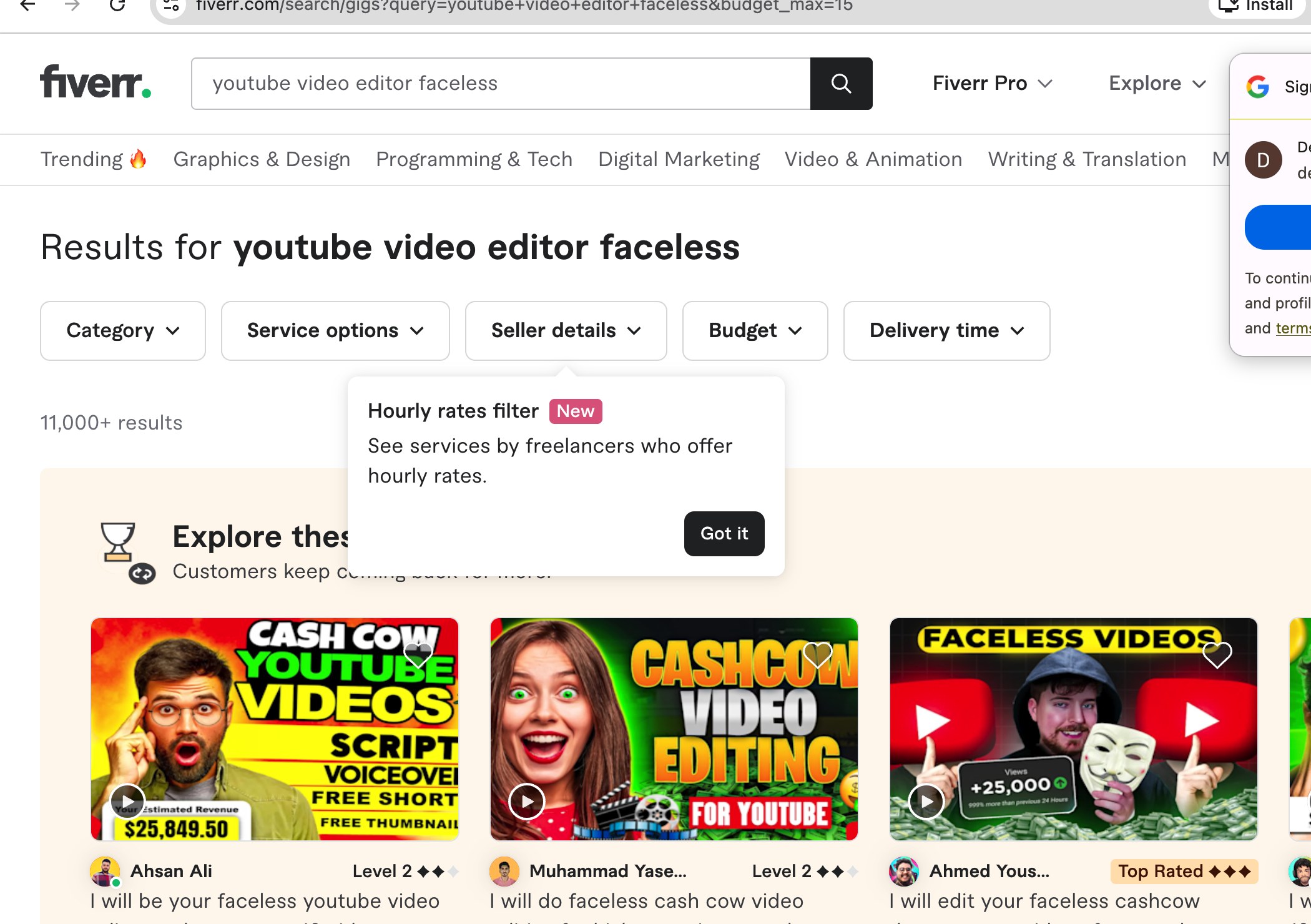
Your biggest cost is editing, and it scales linearly. More videos = more editing cost, but also more revenue. At $3-$8 per video from overseas editors, you're looking at $24-$64 for 8 videos. If those 8 videos generate $2,000-$5,000 in their lifetime, the ROI is 30x-200x. There is no other business model with this math.
Every faceless video follows the same five-step production pipeline. This is the system I teach inside Faceless Channel Academy, and it's the same system my own team runs every week.
You don't guess what to make videos about. You look at what's already working in your niche, top-performing videos from competing channels, trending searches, seasonal spikes, and you identify gaps. A validated topic has three things: proven demand (someone else got views on it), a fresh angle (you're not copying the exact same video), and keyword alignment (people are actually searching for it).
Scripts follow a hook-story-payoff framework. The first 30 seconds determine whether someone stays or leaves. The middle section keeps them through curiosity loops and value stacking. The ending drives either a subscribe, a click to the next video, or both. AI tools that actually work like ChatGPT generate first drafts. You (or your scriptwriter) refine them to match your channel's voice. A 10-minute script takes 30-60 minutes to produce.
Two paths: AI voiceover (ElevenLabs, WellSaid, PlayHT) or human voiceover (Fiverr, Upwork, in-house). AI is faster, cheaper, and in 2026 the quality gap is nearly gone. Most of my students start with AI voiceover and only upgrade to human when their channel is generating enough revenue to justify the cost difference. Budget: $0 for AI (included in tool subscription) or $5-$20/script for human.
The editor takes the script, voiceover, and a reference folder (stock footage links, style notes) and builds the video. Turnaround is typically 24-72 hours for a 10-minute video. You review it, request revisions, and approve. This is the step you outsource from day one. If you're editing your own faceless videos, you're not running a business, you're doing a hobby.
Thumbnail and title are responsible for 80%+ of whether a video gets clicked. We test multiple title formats, follow proven thumbnail frameworks (high contrast, 3 elements max, readable at mobile size), and schedule uploads at optimized times based on your audience's watch patterns. This step takes 15-30 minutes per video.
This is where 90% of new faceless creators fail before they start. They pick a niche because it "sounds interesting" or because they saw one success story in that space. Then they grind for 6 months in a niche with $3 RPMs and wonder why they're not making money.
Here's how we actually validate a niche inside FCA:
You're not picking a "passion", you're picking a market. The best niche is one where RPMs are high, competition is manageable, demand is proven, and the content is producible at scale. Passion is a bonus. Profitability is the requirement.
YouTube requires 1,000 subscribers and 4,000 watch hours (or 10M Shorts views) in the past 12 months to join the YouTube Partner Program and start earning ad revenue. Here's what a realistic timeline looks like for a faceless channel publishing 8-12 videos per month in a validated niche:
| Milestone | Typical Timeline | Student Data Point |
|---|---|---|
| First 100 subscribers | 2-4 weeks | , |
| Monetization (YPP) | 30-120 days | Michelle C., 30 days; Tianna, 39 days; Shehzad, 52 days |
| $1K/month | 3-6 months | Shehzad, $875 in first week post-monetization |
| $5K/month | 6-12 months | Multiple FCA students in this range at month 8-10 |
| $10K+/month | 7-18 months | Vaishnavi B., $10K/mo in 7 months; Amith J., $10K/mo in 3 months |
These aren't cherry-picked outliers. These are students from our community who followed the system, stayed consistent, and let the compounding work. Amith J. is notable because he hit $10K/month in just 3 months, that's unusually fast, and it's because he chose a high-RPM niche and published aggressively. Vaishnavi B. did it while working full-time as a surgeon and raising a toddler. If she found the time, the "I'm too busy" excuse doesn't hold up.
Numbers are easy to make up. Names aren't. Here are real FCA students with real, verifiable results on Trustpilot. We have 1,200+ students enrolled and 4.6/5 stars across 94 reviews.
| Student | Result | Timeline | Background |
|---|---|---|---|
| Shehzad H. | Monetized, $875 first week | 52 days | Brand new to YouTube |
| Michelle C. | Monetized | 30 days | Had tried another course, failed |
| Tianna | Monetized | 39 days | Zero prior experience |
| Vaishnavi B. | $10K/month · 50K subs | 7 months | Full-time surgeon & mom |
| Amith J. | $10K/month | 3 months | No prior content experience |
Every one of these results is publicly verifiable on Trustpilot. They wrote the reviews themselves. We didn't prompt them, incentivize them, or edit them. If you want to read 94 reviews from real people who paid real money and got real results, they're all right there.
Hear it directly from them:
The fastest path to monetization is a high-RPM niche + consistent publishing + expert feedback on your first 10 videos. Most of our fastest-monetizing students got there because we caught their mistakes early, bad thumbnails, weak hooks, wrong upload cadence, on coaching calls before those mistakes cost them months.
After coaching 1,200+ students, the failure patterns are predictable. These are the five mistakes that consistently kill channels that should have worked:
"I like dogs so I'll make a dog channel." Cool. Dog niches average $3-$6 RPM. You'll need millions of views per month to make meaningful money. Meanwhile, the person who validated a finance sub-niche is earning 5x-10x more from the same view count. Every dollar you earn is decided before you publish your first video, at niche selection.
You're not a video editor. Even if you are, you shouldn't be. Every hour you spend editing is an hour you're not researching topics, analyzing performance, or planning your next 10 videos. Editors cost $3-$8 per video from overseas talent pools. If $5 per video is stopping you from scaling, the problem isn't the $5.
YouTube's algorithm rewards channels that publish regularly. Two videos per week is the minimum for growth. One video per week is maintenance mode. One video per month is invisible. The students who stall are always the ones who publish 4 videos one week, then disappear for three weeks, then publish 2 more. Consistency compounds. Bursts don't.
Your video's content is irrelevant if nobody clicks on it. CTR (click-through rate) is the gateway metric. A 2% CTR means your video is dead on arrival. A 6%+ CTR means YouTube pushes it to more people. The difference between a 2% and 8% CTR is almost always the thumbnail and title, not the video itself. Invest here first.
Every mistake you make alone takes 3x longer to identify and fix. A bad hook costs you 10 videos before you realize it's the problem. A weak thumbnail strategy costs you months. The students who monetize fastest are the ones who show up to coaching calls, post their analytics, and get real feedback from people who've coached 1,200+ students through the same stalls. If you're weighing your options, see our breakdown of faceless YouTube coaching programs to understand what separates the ones that actually move the needle. The ROI on expert feedback is incalculable.
Once your first channel is monetized and generating consistent revenue, the playbook is simple: replicate the system in a second niche. Then a third. Every channel you add is incremental, the same production pipeline, the same team, the same tools. The only variable is the niche.
Here's what scaling looks like in practice:
| Channels | Monthly Revenue Range | Time Investment | Team Size |
|---|---|---|---|
| 1 channel | $1K, $10K | 10-15 hrs/week | 1-2 contractors |
| 2-3 channels | $5K, $30K | 15-25 hrs/week | 3-5 contractors |
| 4-6 channels | $15K, $60K+ | 20-30 hrs/week | 5-10 contractors + project manager |
I run two channels personally (Across the Globe and Nutty History) with a combined team of editors, scriptwriters, and a thumbnail designer. My total time investment is under 10 hours per week. Most of that is reviewing content, approving uploads, and analyzing performance data. The channels generated $32,149 last month. That's over $3,200 per hour of my time, and that ratio only improves as the channels grow.
The key insight is this: you don't scale by working more hours. You scale by duplicating the system. Every channel you add uses the same SOPs, the same hiring pipeline, and the same quality control process. The only limit is how many project management threads you can hold in your head, and once you hire a project manager, even that limit disappears.
Your first channel is the hardest. Every channel after that is a variation on a proven theme. The system, the team, the tools, they all transfer. Most FCA students who hit $10K/month on their first channel are at $20K+ within 6 months because channel #2 launches faster, cheaper, and with better data.
If you've read this far, you know more about faceless YouTube than 95% of people who will never start. The question isn't whether the model works, you've seen the revenue data, the student results, the cost structure. The question is whether you're going to act on it.
Here are your three options:
Option 1: Go it alone. Use the data in this guide, pick a niche, start publishing. You'll make every mistake yourself and learn from them over 6-18 months. Some people prefer this path, and it does work, eventually. The cost is time.
Option 2: Watch the free training. I recorded a full breakdown of the system, niche selection, production pipeline, team hiring, scaling, and it's free. No email required to start watching. If you want to understand the full picture before making any decisions, start there.
Option 3: Talk to an FCA Advisor. Book a free strategy call. They'll look at your situation, your niche ideas, your timeline, and tell you honestly whether FCA is the right fit. If it's not, they'll tell you that too, several Trustpilot reviewers specifically mention being told to wait or try a different approach first. No pitch deck. No countdown timer. Just a real conversation about whether this makes sense for you right now.
Before choosing a program, see our best faceless YouTube courses compared for a direct side-by-side.
1,200+ students. 4.6/5 Trustpilot. Real channels, real revenue, real coaching. Talk to an advisor and see if FCA is the right fit for where you are right now.
Book a Free Strategy Call →Not ready? Grab the free niche research template and start validating on your own.